By Malee Gunaratne | March 7, 2026, Fractional project management
Hiring a full-time PM for a six-month problem is overkill. Hoping a consultant will fix your chaos with only a strategy deck is wishful thinking. Fractional project management sits in the middle and it’s better than both.
I recently posted about having fractional PM slots open, and this is a good time to break down what that means.
So let’s break it down.
I wrote about how project management experience translates to building portfolio careers. This is what that looks like when you structure it as fractional work, from both perspectives.
For companies, it’s a practical solution to a temporary problem. For PMs, it’s a bold move – building a career outside traditional employment, betting on your expertise to generate income across multiple clients instead of climbing one corporate ladder.
What Fractional Project Management Actually Is
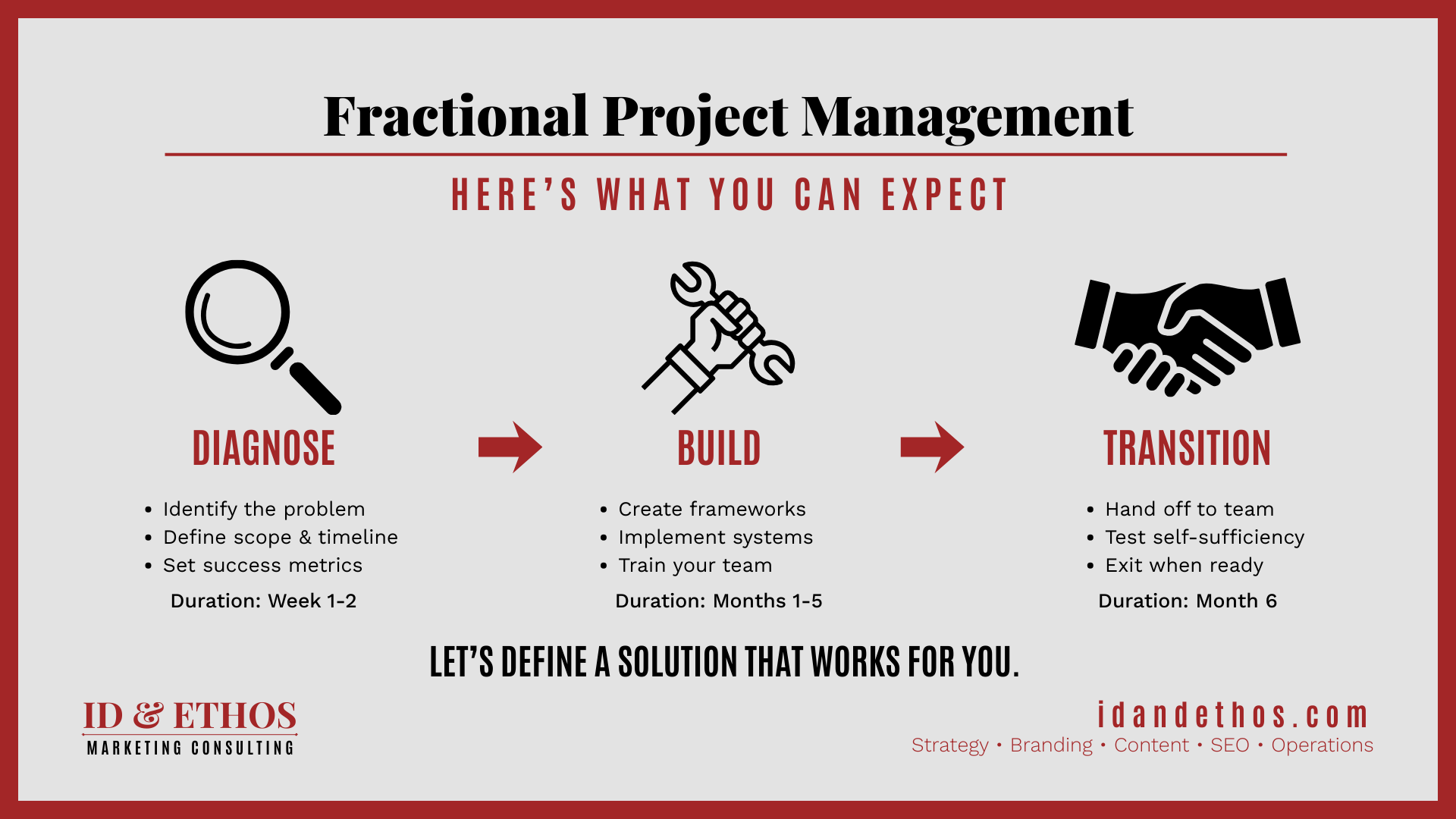
Fractional PM means bringing in experienced project management expertise for a defined period to solve a specific problem or build a specific system. It’s not consulting in the traditional sense where someone gives you a strategy document and walks away. Nor is it a permanent hire where you’re committing to long-term overhead.
The solution is temporary, high-leverage work focused on building something that continues after the engagement ends.
The Company Side: When Fractional Project Management Makes Sense
Most companies I talk to know they have project management problems. Marketing campaigns aren’t launching on time. Cross-functional teams aren’t coordinating. Product launches feel chaotic. Systems that worked at 10 people don’t work at 30.
But hiring a full time PM doesn’t always make sense.
Maybe you’re not sure if the role is permanent yet. Maybe you need someone senior but can’t afford that salary year round. Maybe you just need help building the framework and then your team can run it.
That’s where fractional PM works.
Here’s what it looks like:
A 3-6 month engagement focused on a specific outcome. Build the marketing and/or operations framework. Set up cross-functional project workflows. Create the system that tracks what’s actually working. Train your team to run it. Then step back. You get senior PM expertise without full-time overhead. The engagement is defined, measurable, and designed to make you self sufficient.
Common scenarios where this works:
Scaling marketing operations: You’re growing and your marketing feels scattered. You need an expert to build the infrastructure (campaign plan, execution, and tracking) and train your team on it.
Product launches: You’re planning a major launch and your internal team is already stretched thin. You need someone to manage the timeline, coordinate departments, and make sure nothing falls through the cracks.
Cross-functional coordination: Your teams aren’t talking to each other and projects are stalling. You need the the communication structure built with every role aligned.
Restructuring operations: You’re changing how work gets done and need to manage the transition without disrupting current projects.
The engagement comes to a close when the system is built and your team can run it independently.
The Structure: How Fractional PM Engagements Work
Timeline: Most engagements run 3-6 months. Some companies need ongoing support beyond that for larger annual projects, and that’s fine. The key is defining what success looks like upfront.
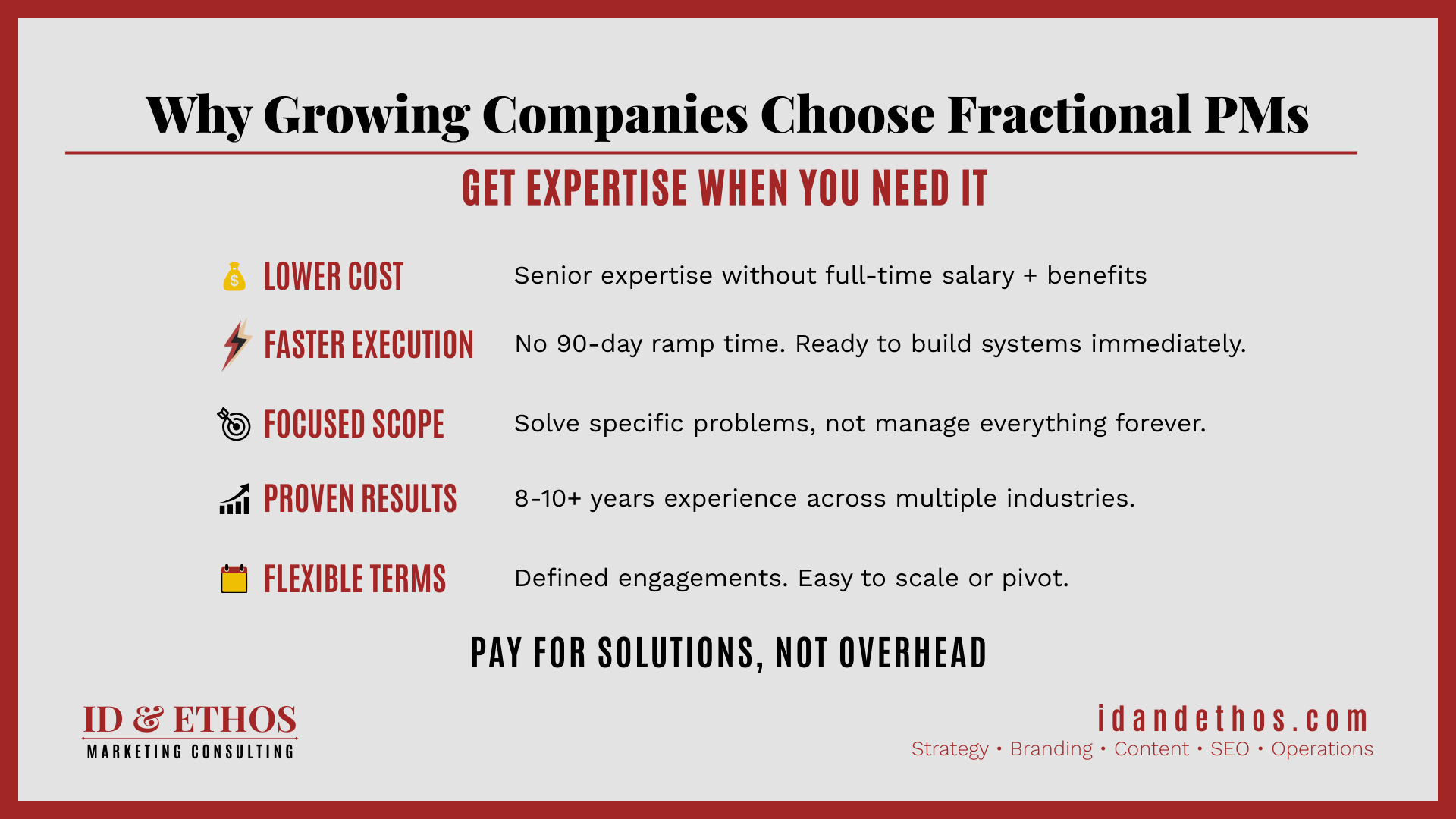
Scope: Fractional work is focused. You’re not hiring someone to manage everything forever. You’re hiring them to build something specific: a framework, a process, a system that solves the problem you identified.
Involvement: This isn’t remote consulting where someone checks in once a week. Fractional PMs work alongside your team, embedded enough to understand how things actually work but not on payroll permanently.
Outcome: The goal is always to make you self-sufficient. You shouldn’t need the fractional PM indefinitely. If the system requires constant external support to function, it’s not built right.
Why Companies Choose Fractional Over Full-Time
Cost: You pay for expertise when you need it, not year-round. A 6-month fractional engagement costs significantly less than a full-time senior PM salary plus benefits.
Flexibility: You can scale up or down based on actual need. If the project wraps early, you’re not stuck with headcount you don’t need.
Speed: Fractional PMs come in ready to execute. No 90-day ramp time. They’ve done this before and know how to build systems quickly.
Expertise level: You get senior-level experience without senior-level permanent salary. Most fractional PMs have 8-10+ years of experience across multiple industries.
No long-term commitment: If it doesn’t work, the engagement ends. You’re not managing a termination process or dealing with replacement hiring.
The PM Side: Why Fractional Project Management Fits Portfolio Careers
Going independent as a fractional PM is a bold move. You’re betting on your expertise, your ability to deliver results, and your capacity to build a sustainable business.
Here’s why it works:
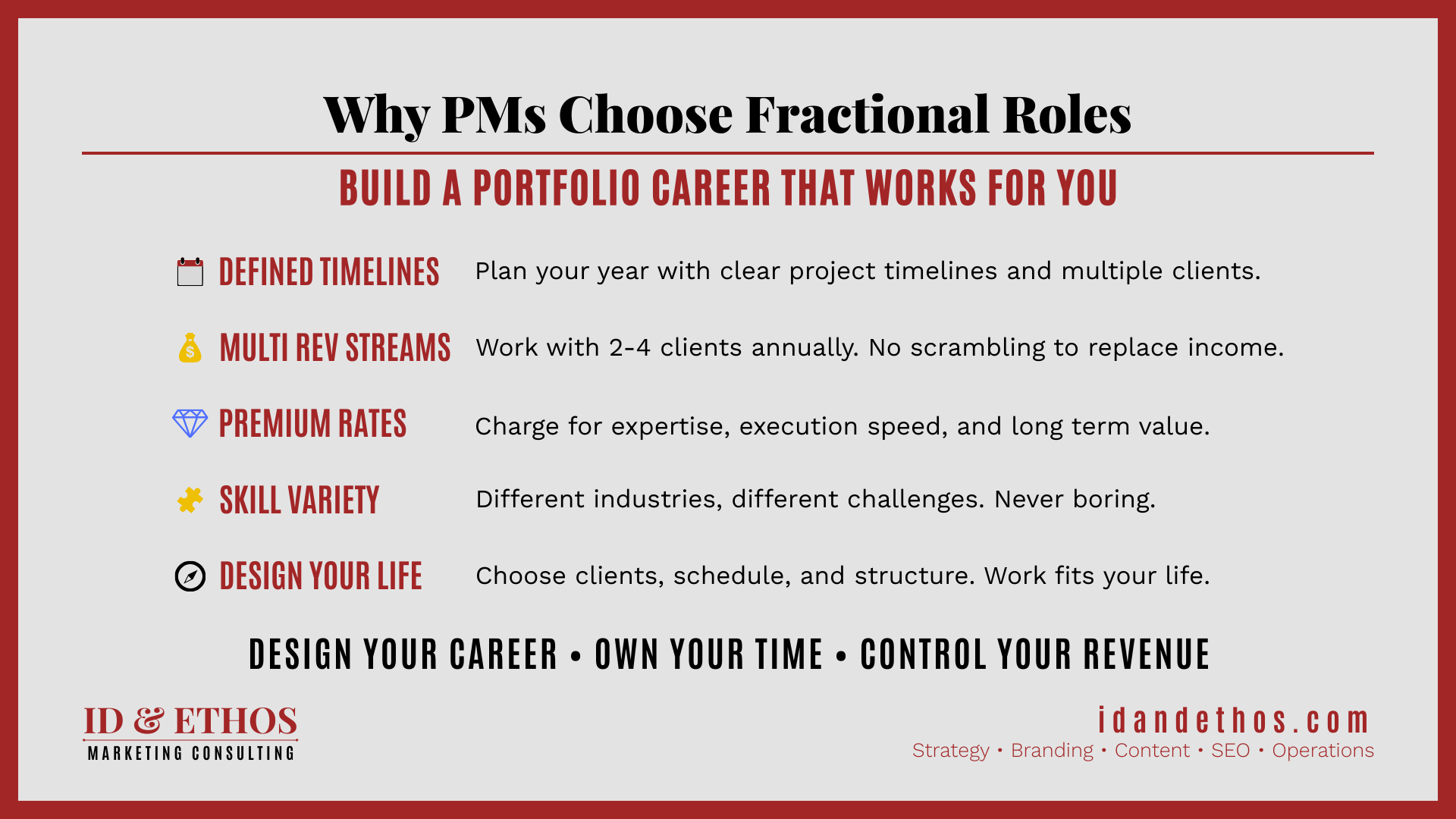
Defined timelines: 3-6 month engagements mean you know when projects end and when you have capacity for new work. You can plan your year around multiple clients instead of hoping for continuous contract renewals.
Multiple revenue streams: Instead of one client paying you, you work with 2-4 clients throughout the year. If one engagement ends early, you’re not scrambling to replace 100% of your income.
Higher rates: Fractional work commands premium rates because companies are paying for expertise and speed, not just time. You can charge more than you would as a full-time employee or traditional contractor.
Skill variety: Working across different companies and industries keeps the work interesting. You’re not solving the same problems repeatedly. Each engagement brings new challenges and expands business knowledge.
Design Your Life: Making the move to fractional work requires confidence. It’s not the safe path, it’s a strategic choice.
You choose the clients, when to schedule projects, and how to structure your time. You’re choosing to build a career that fits your life. Making the move to fractional work requires confidence. It’s not the safe path, it’s a strategic choice.
A Note on Credentials
Not all fractional PMs come with formal certifications, and that’s okay. What matters most is whether you can diagnose problems, build systems, and deliver measurable results.
That said, credentials like those offered by the Project Management Institute – including PMP (Project Management Professional) or certifications in Agile methodologies – can strengthen your positioning as a consultant. They signal to potential clients that you understand standardized frameworks and best practices.
I’ve worked alongside certified PMs who brought excellent structure to complex projects. Their formal training gave them tools that benefited their teams and outcomes.
Whether you pursue formal credentials or learn by doing, the key is demonstrating that you can solve the specific problems your clients face.
An Unconventional Option
I wrote about how PM skills translate to building portfolio careers. Fractional PM work is one way to actually structure that. It’s unconventional for companies who are used to thinking in terms of full-time hires or nothing. It’s unconventional for PMs who were taught that career success means climbing a corporate ladder.
But it works.
Companies get the expertise they need without permanent overhead. PMs get the income and flexibility to build careers on their own terms. Both sides win when the engagement is structured right.
If you’re a company dealing with project management chaos and you’re not ready for a full-time hire, explore how we can help.
If you’re a PM thinking about going independent but you’re not sure how to structure the work, fractional engagements give you a proven model.
It’s just another way to do it.