By Malee Gunaratne | June 1, 2026
You are already doing all the marketing. Posting, planning, promoting, maybe even paying for ads. But if someone asked you to explain exactly why last month worked or did not work, could you? If the answer is no, you do not have a marketing system. You have a collection of things you do and hope for the best.
Treating marketing like the weather, as something that just happens, is a symptom of the same problem: no system underneath the effort, producing inconsistent results that drain momentum before you even notice it is happening. That gap is exactly what this series closes.
If you missed the intro, start here: WTSFest: Unlock and Ignite Your Marketing.
Here is the first real lesson in the series. Welcome to Marketing Systems 101.
What Is a Marketing System?
Before we can fix anything, we need to define what we are actually talking about.
Three books shaped how I think about this. Mike Rother’s Toyota Kata argues that sustainable improvement comes from repeatable routines, not tools or one time workshops. Scott Brinker’s Hacking Marketing makes the case that modern marketing has more in common with software development than with traditional campaign management. And John Doerr’s Measure What Matters establishes that without a clear system for measuring what actually drives outcomes, even the best strategy is expensive guessing.
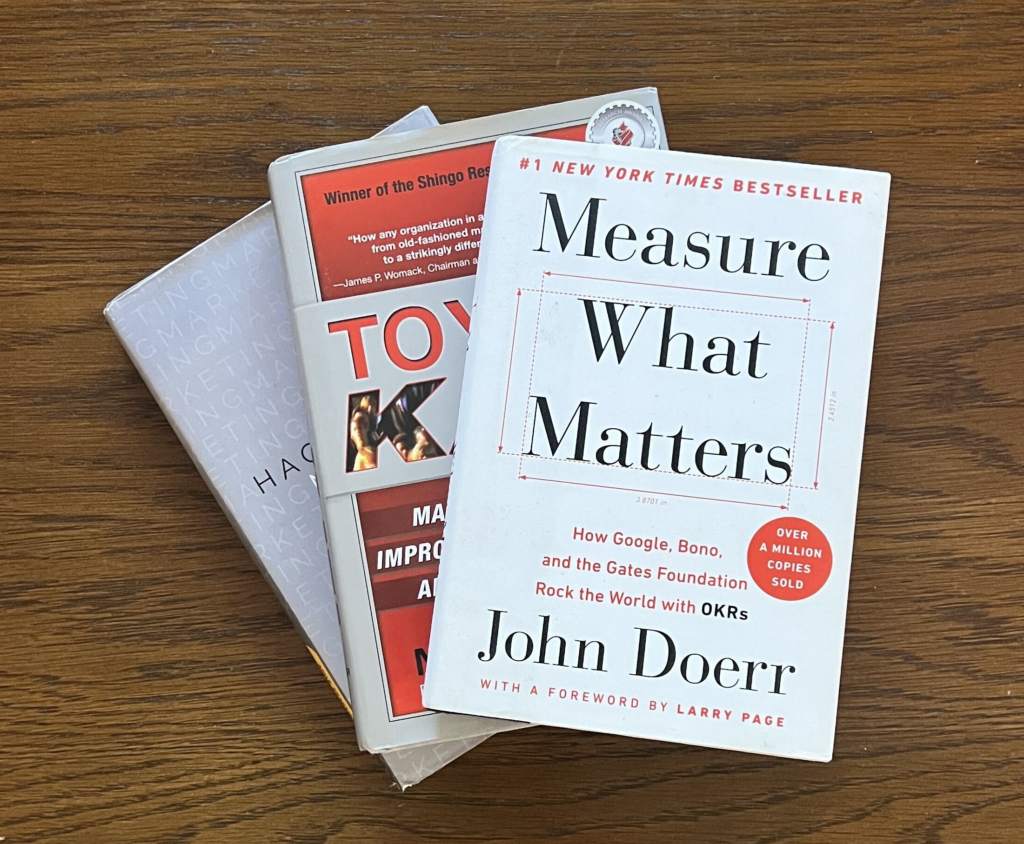
All three arrived at the same conclusion from different directions: structure is not the enemy of creativity. It is what makes creativity sustainable. And measurement is not the enemy of momentum. It is what tells you whether the momentum is real.
That is the intellectual foundation this series is built on.
What a System Is Not
A marketing system is not as simple as a tool. Buying a CRM, signing up for a scheduling platform, or downloading a content calendar template is not building a system. Those are components. A system is what happens when those components have a clear purpose, connect to each other, and produce a repeatable result without you having to reinvent the wheel every time.
This is exactly what Rother argues about Toyota. The company’s success did not come from the tools they used. It came from the routines built around those tools. The tools were replaceable. The routines were not.
A system is also not a rigid process that removes all flexibility. Good systems bend. They account for the reality of how you actually work, not just how you wish you worked.
What a System Actually Is
A marketing system is a set of connected decisions and actions that produce a consistent, measurable output.
It answers three questions:
- What needs to happen? (the inputs)
- How does it happen? (the process)
- How do you know it worked? (the output and measurement)
When all three are defined, you have a system. When one is missing, you have a workflow that depends entirely on you remembering what to do next.
Brinker frames this through the lens of software development. In engineering, you do not ship a product and hope it works the same way next time. You build a process that makes the output predictable. Marketing deserves the same standard.
Doerr calls the third question the most important one. In Measure What Matters he argues that most organizations can articulate what they want to do and roughly how they will do it. What they cannot do is define how they will know if it worked. That gap is where strategy goes to die. Marketing is no different.
What Makes a System Good
Not all systems are created equal. A good marketing system has four qualities.
It is built for how you actually operate.
A system that requires three hours of prep every Monday when you have client calls all morning is not a good system for you. The best systems account for your actual constraints: your time, your team size, your energy patterns, your compliance requirements.
It is repeatable without starting from scratch.
Every time you execute a campaign, send a newsletter, or post on social media, you should be able to follow the same process without rebuilding it from memory. Templates, checklists, saved content frameworks: these are what make a system repeatable.
It has measurement built in.
You should know what success looks like before you start, not after. A good system defines what you are tracking and why. Not vanity metrics that look good on a dashboard, but metrics that tell you whether your marketing is actually moving your business forward.
Doerr’s framework for this is OKRs: Objectives and Key Results. The objective defines what you are trying to achieve. The key results define how you will know you got there, with specific measurable outcomes attached to a timeline. You do not need to implement OKRs formally to use this thinking. You just need to answer the question before you start, not after.
It can be handed off.
If you hired a new employee tomorrow, could they follow your system and produce a similar result? If the answer is no, it is not a system. It is a set of habits that live in your head. In manufacturing we called it tribal knowledge. Systems outlive any one person’s involvement.
What This Looks Like in Practice
A financial services client came to me struggling with consistency. She was posting sporadically, unsure what to say on which platform, spending significant mental energy on marketing decisions that should have been routine, and working under strict regulatory guidelines that limited the kind of content she could produce independently.
We built her a content system from the ground up using the corporate playbook as the cheat code.
The first step was clarity: what are the platforms, what is the purpose of each, and what does her audience actually need from her in that space? LinkedIn for thought leadership and professional credibility. Instagram for approachability and connection. Two different audiences, two different tones, one consistent brand.
The second step was structure: a content calendar that gave her a scaffold instead of a blank page. Not a rigid script, but a framework. This week, talk about this angle. Next week, connect this topic to the upcoming season. The scaffold gave her direction without removing her voice.
The third step was measurement: how do we know this is working? We defined what she was tracking and what those numbers actually meant for her business. Not just follower counts, but engagement from the right people, inquiries from social, referrals that mention her content. Doerr would call these her key results. The objective was simple: show up consistently and build trust with the right audience. The key results told us whether it was working.
The result: she stopped dreading her marketing. It became routine instead of a negotiation with herself every week. The system did the heavy lifting so she could focus on the relationships.
That is the corporate playbook distilled into a small business reality. Not complicated. Not expensive. Structured.
How to Know If You Need a Marketing System
If any of these sound familiar, you need a system:
- You post when you remember to post.
- Every campaign feels like starting from scratch.
- You know your marketing could be better but you do not know where to start.
- You are spending time on marketing decisions that should be automatic by now.
- You cannot tell whether your marketing is actually working.
How to Start Building One
You do not need to overhaul everything at once. Start with one area of your marketing that feels chaotic and ask the three questions:
- What needs to happen here?
- How should it happen, step by step?
- How will I know if it worked?
Write it down. Test it. Adjust it. That is a system in its earliest form.
The goal is not perfection. It is repeatability. A repeatable system that is 80% optimized will always outperform a perfect plan you never execute consistently. That is Toyota Kata applied to marketing. Improve the routine, not just the output.
And as Doerr puts it: ideas are easy. Execution is everything. A system is what turns the idea into the execution, repeatedly, without starting over every time.
Next week: The System You Already Have. Because whether you built it intentionally or not, you already have one.
If you are a founder or business owner:
You are probably running your marketing on a combination of instinct, memory, and whatever worked last time. That is where almost every founder starts. The question is whether you are ready to stop rebuilding from scratch every time and start running something repeatable. Apply the three questions from How to Start Building One as your starting point. Pick one area of your marketing and answer them this week.
If you are on a marketing team:
The four qualities of a good system are also a diagnostic tool. Run your current marketing operation against them. Is it built for how your team actually works? Is it repeatable? Does it have measurement built in? Can it be handed off? Wherever the answer is no, that is where the system is breaking down. That is also where your next conversation with leadership needs to start.
This is Part 1 of Marketing Systems 101, a 10-part series on building marketing systems that hold weight. New posts publish every Friday. Subscribe to get the full series delivered to your inbox.
Malee Gunaratne is the founder of Id & Ethos Marketing Consulting, a diagnostic-first consultancy that helps small businesses escape the matrix with marketing strategy, content, and systems built from the corporate playbook.