By Malee Gunaratne | June 13, 2026
Last week we mapped the system you are already running. This week we break it.
Not to set you up for failure. But because understanding where and why a system fails is the only way to know what to fix. And the answer is almost never what you think it is.
The assumption is usually that the problem is execution. That the team is not working hard enough to post or measure. But when you trace marketing failures back to their source, execution is rarely where the break actually happens. It is almost always structural.
If you are catching up, start with Part 1: What Is a Marketing System? and Part 2: The System You Are Working With Now.
The Real Problem With How Marketing Systems Break
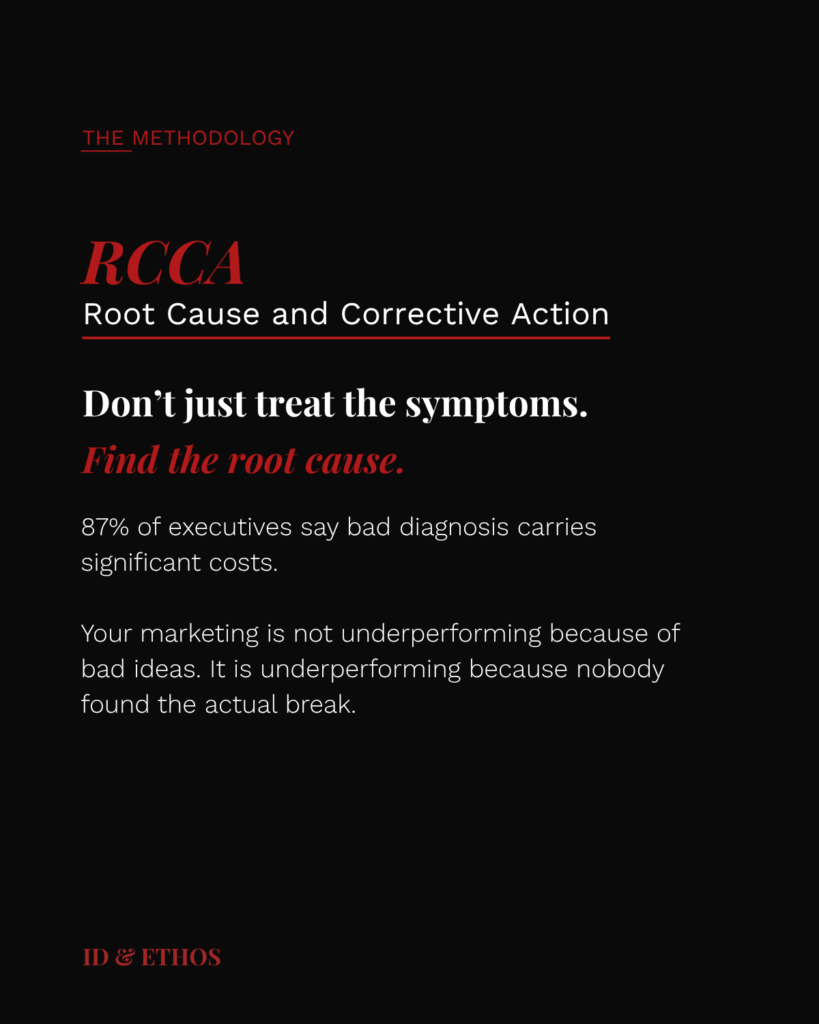
In semiconductor manufacturing I worked with a methodology called RCCA: Root Cause and Corrective Action. When results were inconsistent, you did not guess at the fix. You traced the problem back to its source, documented what you found, implemented a corrective action, and verified the fix held over time.
The discipline was straightforward: do not treat symptoms. Find the root cause.
Root cause analysis is not unique to manufacturing. Harvard Business School describes it as one of the most critical organizational leadership skills, and the data reflects it: 85 percent of executives believe their organizations are bad at diagnosing problems.
Marketing is no exception. The symptoms are what you can see: inconsistent output, missed deadlines, campaigns that underperform, content that never gets published. But the root causes live deeper. And if you only address the symptoms, the same problems come back wearing a different outfit.
That is why it feels like you are constantly fixing the same things.
Six Ways Marketing Systems Break
These are not theoretical. These are the patterns that show up repeatedly across businesses of different sizes, industries, and stages, from solo operators to full marketing departments.
1. Nobody owns the outcome.
Work gets done. But nobody owns whether it worked.
There is a real difference between being responsible for sending the email and owning whether the email accomplished anything. When ownership stops at the task level, the system produces activity without direction. People complete their piece and move on without ever asking whether the whole thing landed.
Doerr calls this the gap between output and outcome. Objectives and Key Results exist specifically to close that gap, connecting every task to a measurable result. Without that connection, nothing compounds. You are busy every week and further behind every month.
2. The process exists but nobody follows it.
This one is infuriating because it looks like a discipline problem. The process is documented. Everyone knows where to find it. And nobody uses it.
Shortcuts become standard. Deadlines become suggestions. The process becomes decoration.
The instinct is to blame the people. But here is the tell: when an entire team consistently bypasses a process, the process is the problem, not the team.
In urban planning there is a concept called desire paths. An architect designs the walkways they think people should use. Then people wear their own routes based on where they actually need to go. Some planners fight it with signs and fences. Others, the ones who have learned something, observe where the paths form and pave those instead. Some university campuses wait an entire semester before pouring sidewalks, watching where students actually walk, and then building the paths along the trails they wore into the grass themselves.
Marketing processes work the same way. Either the process was designed for ideal conditions that never exist, or it adds friction without adding value, or it was never built with the people who actually use it. Rother makes this point in Toyota Kata: the routines that stick are the ones designed around how people actually work, not how leadership thinks their team works.
The fix is not more enforcement. It is simply better design. Pave the desire path.
3. Everything runs on urgency.
This was the focus of Part 2 but it deserves to be included here as one of the structural failure modes.
When a system has no stable rhythm, urgency fills the vacuum. The system only activates when something is already overdue. None of this feels unusual in the moment. It feels like work. But zoom out and the pattern is clear: nothing moves until pressure forces it to.
Systems that only activate under pressure produce inconsistent results because the input is inconsistent. You cannot get predictable output from unpredictable input. Period.
Urgency is not a motivator. It is a symptom of missing structure.
4. Priorities shift and nobody communicates the change.
The direction changes. The system does not.
A competitor does something unexpected, or a new initiative absorbs the room’s attention, and leadership pivots. But the team is still executing last month’s priorities while leadership is already thinking about next quarter. Work continues. It looks productive but it is producing diminishing returns because the foundation shifted and nobody told the people building on top of it.
This is not a communication failure in the way people usually mean it. It is a systems failure. A well-designed system has a mechanism for cascading priority changes through every layer of execution. When that mechanism does not exist, misalignment is not a risk. It is a certainty. You just do not feel it until the results come back flat and nobody can explain why.
5. Teams solve the same problem in silos.
Marketing is working on brand awareness. Sales is building outreach materials. Customer success is creating onboarding content. All three are solving for the same underlying problem: how to communicate value. None of them know the others are doing it.
The result is three teams producing three different versions of the same message, none of them aligned, all of them convinced their version is the right one.
This happens when the system does not include cross-functional visibility. When there is no shared view of what is being built and why, each team defaults to solving their own version of the problem independently. The fix is not more meetings. More meetings without shared objectives just means more people in a room still working in silos. The fix is structural: shared objectives, shared assets, and a system that makes collaboration the path of least resistance rather than an extra step.
6. Activity becomes the goal.
This is the quietest and most dangerous failure mode because it does not look like a problem from the outside.
Content is being published. Campaigns are running. Dashboards have data in them. It looks like marketing is happening. But none of it is connected to a business outcome.
The team is posting because the calendar says to post. Running ads because the budget was allocated. Producing reports because someone expects a report. Nobody is asking whether any of it is moving the business forward because the activity itself has become the measure of success.
Activity without purpose is not marketing. It is motion. And motion without direction creates the illusion of progress while the business stays exactly where it was.
Scott Brinker frames this in Hacking Marketing as the difference between being busy and being effective. Software teams learned decades ago that shipping features is not the same as shipping value. Marketing has the same lesson to learn. And it starts with asking one uncomfortable question: if we stopped doing this tomorrow, would anyone notice?
Why These Patterns Repeat
Every one of these failure modes has the same underlying structure. A system that was never intentionally designed is producing exactly what it was built to produce, even though nobody built it on purpose.
They all look like people problems on the surface. But people do not override systems. They adapt to them.
If the system rewards urgency, people operate with urgency. If the system lacks clarity, people fill the gap with their own assumptions. If the system does not connect activity to outcomes, people optimize for activity. Not because they do not care. Because the system never gave them anything better to optimize for.
The people are not broken. The system is.
How to Trace the Break
When you encounter a marketing problem, resist the instinct to fix it immediately. Instead, ask three questions:
- What is the symptom?
- This is what you can see. Missed deadlines, inconsistent content, underperforming campaigns, confusion about priorities.
- Where is the break?
- Trace the symptom back through the system. Follow the workflow. Where did it stall? Where did the handoff fail? Where did the decision get made that led to this outcome?
- What is the root cause?
- The break is usually not the root cause. The root cause is the structural condition that allowed the break to happen. Missing ownership. Absent process. No measurement connecting activity to outcomes.
Fix at the root cause level and the symptom resolves. Fix at the symptom level and you will be fixing the same thing again in six weeks.
Next week: The Structural Requirements. Now that you know where systems break, we build what they actually need to hold.
If you are a founder or business owner:
Pick the failure mode from this list that sounds most like your business right now. Then trace it. What is the symptom you are seeing? Where does the workflow actually break? What structural condition is allowing it to happen? Write down all three. That exercise alone will show you more about your marketing than any strategy document ever has.
If you are on a marketing team:
Read through all six failure modes and identify the top two operating in your organization right now. Then ask yourself: when was the last time anyone addressed these as structural issues rather than performance issues? If the answer is never, that is the conversation your team needs to have next.
This is Part 3 of Marketing Systems 101, a 10-part series on building marketing systems that hold weight. New posts publish every Friday. Subscribe to get the full series delivered to your inbox.
Malee Gunaratne is the founder of Id & Ethos Marketing Consulting, a diagnostic-first consultancy that helps small businesses escape the matrix with marketing strategy, content, and systems built from the corporate playbook.